
Protecting Dolpa’s Snow Leopards by Strengthening Indigenous Values: An FoNSupported Snow Leopard Sisters Project
By King Beach
The snow leopard, a globally vulnerable and elusive big cat, faces growing threats across the Himalayas. In Dolpa, the remote high-altitude district in northwestern Nepal, around 90 snow leopards share a fragile mountain ecosystem with traditional herding communities. These communities rely heavily on livestock, leading to rising human-wildlife conflict—especially retaliatory killings following livestock losses—that are causing a worrying decline in snow leopard populations. Over the past 8 years, 11 snow leopards have been found dead, though this probably underestimates the actual loss. You may remember Peter Matthiessen’s 1974 book, The Snow Leopard, documenting zoologist George Schaller’s and Matthiessen’s ultimately unsuccessful journey to find the snow leopard in Dolpa. Known to the local Dolpo Buddhist and Bön communities for centuries, the elusive snow leopard is considered sacred-a protector of the mountains that sometimes accompanies Guru Rinpoche in Buddhist thangkas. Matthiessen’s book introduced the snow leopard to a larger Western audience via his own journey as a Zen practitioner. Flash forward to 2025: sisters from Dolpa, Tshiring Lhamu Lama and Tenzin Bhuti (Tshiring’s young apprentice), have engaged in a decade-long effort to preserve the Himalayan big cat. They are the subjects of a film, Snow Leopard Sisters, currently making the rounds of international film festivals. The film is not yet available commercially, but a preview of the film can be found at this link: https://www.youtube.com/watch? v=AE_l098CFIc&t=24s.
Determining the best site for a carving. Photo credit: Snow Leopard Sisters
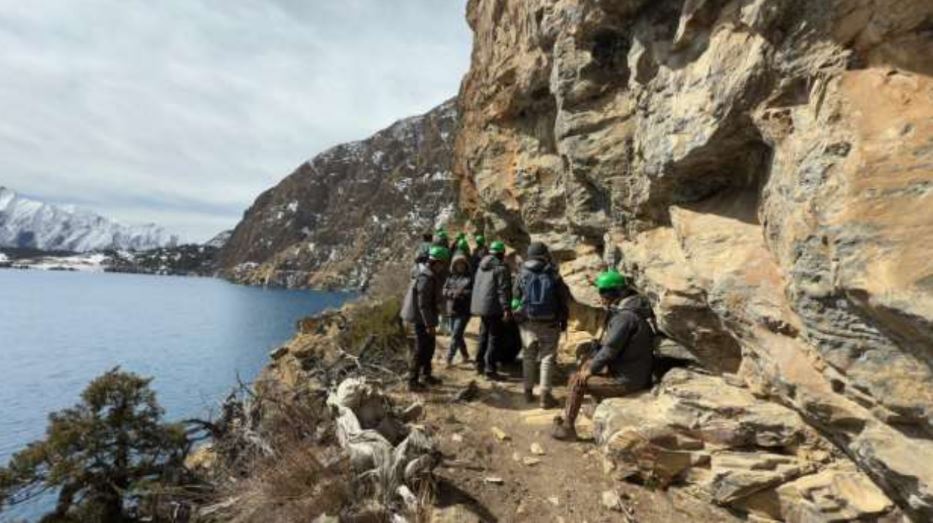
Tshiring la founded the organization Snow Leopard Sisters to work with local communities to protect snow leopards in Shey Phoksundo National Park. Most of the organization’s members are from that area. Government reimbursement to herders for animals killed by snow leopards, while well intentioned, has been largely ineffective. Constructing leopard-proof nighttime corrals, something that the organization itself has been involved in, has its limits as well—particularly during grazing migrations.
Snow Leopard Sisters has now developed a pilot protection program drawing on and strengthening local Vajrayana Buddhist and Bön values and beliefs about snow leopards. With this in mind Snow Leopard Sisters applied to the 2025-26 Friends of Nepal grants program and received an award of $4,890. Six local young adults are currently being trained to serve as “Snow Leopard Messengers.” They will provide snow leopard conservation information and outreach to approximately 150 households and monasteries in the Phoksundo area, including the major villages of Ringmo, Pugmo, and Rike. Messengers will also bestow an Eco-Khata, a biodegradable Buddhist scarf, carrying the blessings of prominent Rinpoches and a printed snow leopard conservation message. Outreach will begin in May of this year and will include a 4-month follow up visit to each household and monastery to reinforce key messages and assess message retention. Rock carvings made by local artisans carrying messages of peaceful coexistence with snow leopards will be permanently displayed along public trails, community centers, and religious sites. Additional community events will be led by respected religious and community leaders in support of the effort. Participants will be encouraged to verbally commit to supporting snow leopard conservation and coexistence, such as by reporting sightings promptly, avoiding retaliation, protecting prey species, improving livestock management, and supporting sustainable livelihoods.
Pre- and post-campaign household surveys will assess changes in behaviors toward, perceptions of, and understandings of human-snow leopard interactions and the importance of not conducting retribution killings. The survey results will be an important window for Snow Leopard Sisters on how local community practices and Buddhist values can be used in the service of snow leopard conservation, as well as on what does not work well and should be modified for the future.