Dear Friends of Nepal Members,
(A message to our members and donors on September 17, 2026)
It has been a difficult time for all of us who care about Nepal. According to Nepal’s Ministry of Foreign Affairs, approximately 5,130 people remain missing and 1,385 bodies have been recovered from flood-affected areas. The National Disaster Risk Reduction and Management Authority estimates that reconstruction will cost approximately $4.7 billion.
In more positive news, at least 13,676 people have been rescued so far, and 13.54 billion NPR (about USD $89 million) had been donated to the Prime Minister’s Disaster Relief Fund as of September 12. The Nepali government, and others working in Nepal, are now transitioning from rescue efforts to relief.
We are proud to say that, in this difficult time, the Friends of Nepal community has raised nearly $108,000 for flood relief. It has been inspiring to see fellow FoN members and RPCVs sharing our fundraiser with their networks and volunteering their time to assist however they can. We also received a large number of donations from people new to our organization and have extended you all courtesy memberships to FoN.
After disasters such as these, there is often an immediate influx of donations to a country that then tapers off as donors shift to the next priority. This trend is exacerbated by the overall decrease in development funding due to the closure of USAID. Meanwhile, it will take families years to rebuild their lives. Friends of Nepal has a long history working in Nepal, including on the 2015 earthquake relief efforts, and we will still be working in Nepal after the initial inflows of relief funding have dried up.
Since the flooding, our grants committee* has been hard at work putting together a plan for how best to spend your generous donations to maximize the impact of our flood relief efforts. Three of our grants committee members, as well as one former member, are currently in Nepal, and have visited aid distribution centers, gombas where dislocated people are sheltering, and government ministry offices. They have held meetings with government officials, FoN partners from previous grant cycles, teachers and students in flood-affected areas, and others working closely on relief efforts.
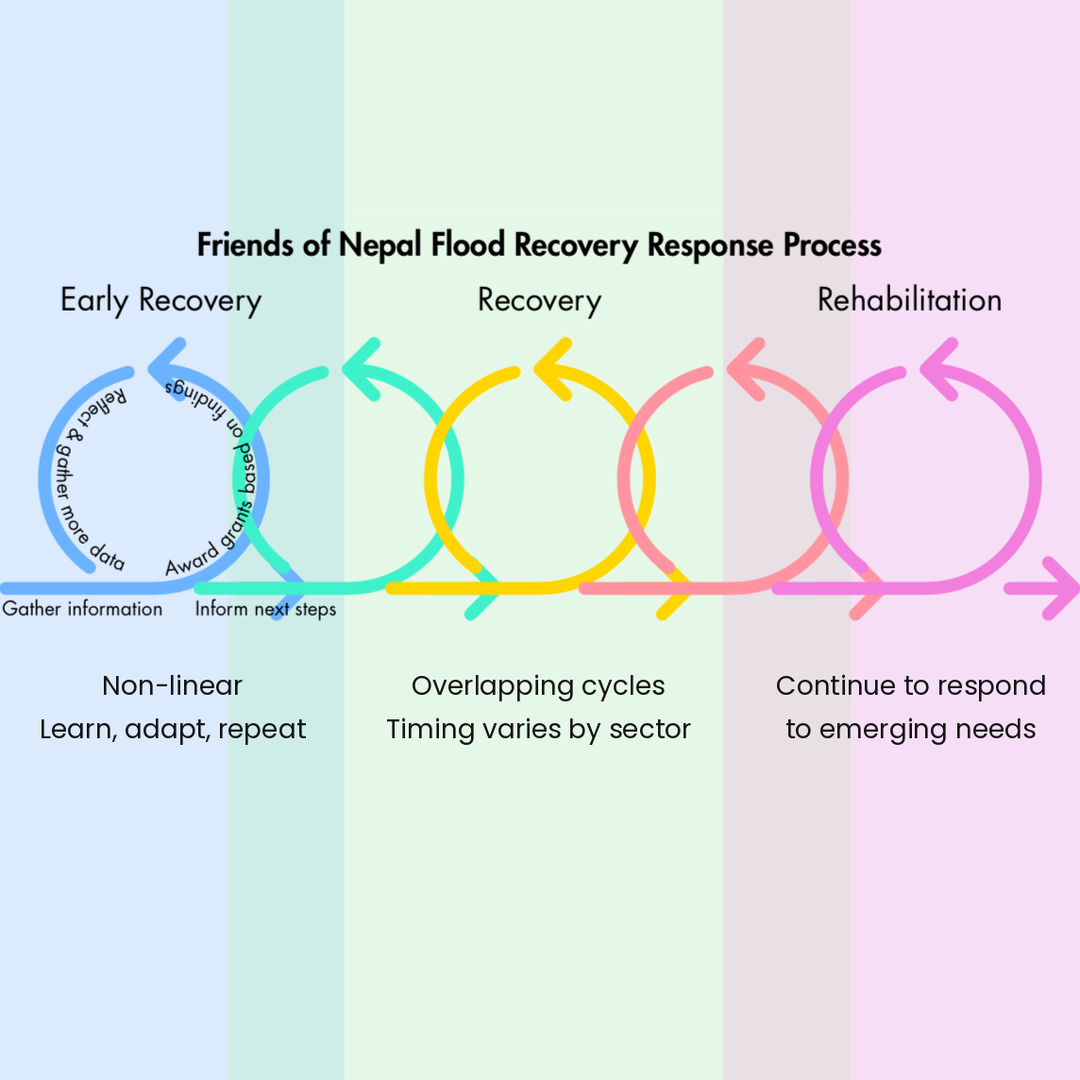
Through these various meetings, the committee has been gathering information to inform our approach for administering funds to ensure that it is in alignment with evolving government policies and intentional in meeting the needs of affected communities and individuals. Because needs will continue to evolve (e.g., early needs are often focused on immediate relief whereas later needs center on rebuilding lives), we will take a phased approach that allows us to adapt to emerging needs and information. The phases outlined below are a general approach: They may not be perfectly linear and may be adjusted as the situation evolves.
Phase 1: Immediate relief efforts. We have already donated $10,000 to the Prime Minister’s Disaster Relief Fund. As FoN member and returned volunteer Peace Corps Nepal group N1 member Mac Odell wrote to us in an email, the Government of Nepal is well equipped with a “fleet of choppers, aircraft, heavy equipment, and Gurkha soldiers/military and local networks.” Indications are that they are working diligently. That said, our grants committee members are actively monitoring to see if there are unaddressed gaps or populations that we can use our funding to support at this time.
Phase 2: Assessing Needs and funding opportunities. This work has already begun. We are assessing the needs of the impacted communities to determine where funds from FoN have the potential for the greatest impact (both geographically and sectorally). Based on these conversations, we will identify local organizations working in these communities to fund.
Phase 3 Implementation. Our selected partner organizations will lead all implementation alongside local government officials and community members with support and monitoring from our grants committee members.
Thank you all very much and please don’t hesitate to contact us with any questions.
Best,
Friends of Nepal Board of Directors
*We protect the identities of our grants committee members so they are not overwhelmed by requests for funding. Our grants committee is Co-Chaired by Jacole Douglas, who is in Montana, and an experienced development professional who is based in Kathmandu. It is made up of highly qualified professionals who have been working in Nepal for decades.